Virtual Tourism
VR travel experience featuring Nepal's religious pilgrimages through photogrammetry and 360 video
Tech Stack
Overview
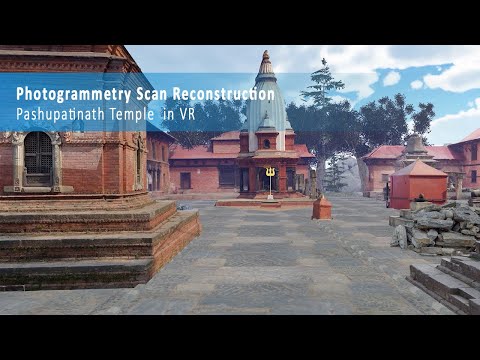
Nepal's religious pilgrimage sites hold immense cultural and spiritual significance, yet many are difficult to access physically. This VR tourism application enables users to virtually visit these sacred landmarks, experiencing them through immersive 360-degree video of actual sites and photogrammetry-reconstructed 3D digital twins. A virtual guide character provides cultural, historical, and spiritual context as users explore each location.
Process & Approach
The project was a collaboration between developers, photogrammetry artists, and videographers. Real-world pilgrimage sites were captured using both 360-degree video rigs and photogrammetry workflows to create complementary experiences: the video provided atmospheric immersion, while the 3D reconstructions allowed free exploration. I developed the VR application framework, integrating both media types into a cohesive navigation system. The virtual travel guide was designed as a 3D character agent that provides narration and contextual information, triggered by the user's location and gaze within each scene.
Key Features
- Immersive 360-degree video of real pilgrimage sites
- Photogrammetry-based 3D digital twins for free exploration
- Virtual 3D guide agent with cultural and historical narration
- Intuitive VR navigation between multiple pilgrimage locations
- Combined video and 3D mesh experiences per location
Technical Challenges
Balancing visual quality with performance was critical — photogrammetry meshes are notoriously heavy, and 360 video requires high-resolution texture streaming. Optimizing both for VR's frame-rate requirements demanded aggressive LOD strategies and texture compression. Designing the virtual guide to feel helpful rather than intrusive required careful UX testing of trigger timing and spatial positioning.
Impact & Learnings
The application demonstrated VR's potential as a cultural preservation and accessibility tool, enabling people who cannot physically travel to experience sacred sites with a meaningful sense of presence. It also served as a case study in combining photogrammetry and video capture for complementary VR experiences.